Put the records on the table. Bring accountability to court. People claiming vaccine injury need answers. We demand transparency, enforcement of valid claims and compensation where a legal entitlement exists.
Civil proceedings. Criminal complaints. The complete files.
We bring together court decisions, criminal complaints and original records. We explain which claims are being examined, what is alleged and which evidence is accessible.
Manufacturing, safety oversight and permits: three criminal-law strands examine individual responsibility. The complaints, supplementary submissions and documented procedural status are available here.
MAINZ
Manufacturing. Marketing. Oversight.
The complaint of 20 March 2026 sets out eight groups of allegations. It concerns 171 affected people or relatives and three batches.
A criminal complaint, an investigation, an indictment and a conviction are different procedural stages. The classification and original records appear alongside each matter.
Tobias Ulbrich with a client · Photo: Rogert & Ulbrich / ru.law
Legal representation
Tobias Ulbrich
He turns demands into concrete proceedings.
At Rogert & Ulbrich, he represents people claiming health damage following COVID-19 vaccination. His work includes disclosure and liability claims, criminal complaints and the consolidation of manufacturing, oversight and batch records.
According to the firm, this involves more than a thousand civil proceedings.
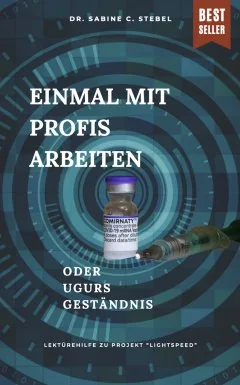
Book image from DrBine’s public Substack profile · not a portrait
Analysis & public debate
DrBine
She makes complex records accessible.
Her newsletter brings court proceedings, manufacturer records and business developments into public debate. We draw on her analysis of 23 October 2026 with direct links to the originals.
She connects information, asks questions and points to documents, drawing attention to the dispute over disclosure and liability. Her interpretation is clearly presented as analysis; the original records are directly accessible.
Share this page. Discuss the documented proceedings. Keep disclosure and accountability on the public agenda.
Bring the questions together. Make the evidence visible.
COVID Liability brings together the questions that matter to affected people: Who might be liable? What evidence is needed? What have courts already decided? Court decisions, official records and other sources are organised by topic and linked directly. Labels distinguish documented facts, reports and broader hypotheses. ‘Documented’ refers to the evidenced event; a company statement is not automatically independently verified.
Document / sourceReport / original outstandingHypothesis / forecast
21 original records: eight court decisions from the collection, the additional Federal Court of Justice judgment, criminal complaints, batch data and records about legal representation. View the 21 original files →
Open the six liability topics
⌕
No matching entry.
Try another search term or classification.
01
Claims & court proceedings
What claims can affected people pursue?
Manufacturer liability, social compensation and state liability have different requirements. The proceedings show how people can obtain disclosure, have evidence assessed and pursue their claims.
Routes to a claim · §§ 84 / 84a AMG · Judgments · Representation
Access to knowledge. Access to justice.
Two legal routes. Different aims.
Civil law: claims of affected people
Obtain disclosure, assess individual damage and its cause, and pursue damages for pain and suffering and other loss.
Criminal law: individual responsibility
Examine concrete grounds for suspicion and establish whether individual participants bear criminal responsibility.
The shared evidential question: What did manufacturers and authorities know about manufacturing, quality and safety — and when?
The legal basis determines the defendant, requirements and procedure.
01
Manufacturer liability
Claims against the pharmaceutical company, particularly under section 84 of the German Medicinal Products Act (AMG), with disclosure under section 84a AMG.
02
Social compensation
Benefits under Book XIV of the German Social Code (SGB XIV), subject to the statutory requirements for vaccine injury. Section 24 covers specified preventive vaccinations.
03
State liability
Damages for an attributable, culpable breach of an official duty owed to a third party, under section 839 of the German Civil Code (BGB) together with Article 34 of the Basic Law.
Success through one route does not automatically meet the requirements of another. Recognition of health damage, manufacturer liability and the responsibility of an official are separate questions.
Section 84a AMG provides access to manufacturer information subject to statutory requirements.
The right covers known effects, side effects, interactions and other findings relevant to assessing potential pharmaceutical liability. It helps affected people assess and prepare a possible damages claim.
In VI ZR 335/24, the Federal Court of Justice (BGH) clarified the disclosure threshold: facts must make a serious possibility of causation plausible. Requiring causation to be more likely than not at this stage sets the threshold too high. Legally protected confidentiality interests may require balancing.
Civil claims and criminal proceedings: two routes, shared evidential questions.
A damages claim does not require a criminal conviction.
Civil law: Affected people seek disclosure from the manufacturer under section 84a AMG and, where appropriate, damages under section 84 AMG. Pharmaceutical strict liability does not require proof of an intentional criminal offence. Its own requirements, particularly compensable damage and the statutory rules on causation, must still be met.
Criminal law: Investigations concern specific acts or omissions and individual responsibility. Prosecutors must investigate where sufficient factual indications exist. A criminal complaint does not prove its allegations.
The connection: Safety assessments, production files, batch testing and the timing of knowledge about possible risks can matter to both routes. Civil disclosure is neither automatic proof of guilt nor conclusive proof of causation. A complaint or prior conviction is not a prerequisite for a civil claim. Investigations do not generally have to await the outcome of civil disclosure proceedings.
Tobias Ulbrich and his firm pursue claims and document complaints; DrBine makes proceedings, records and her own analysis publicly accessible. Their contributions connect legal work with public scrutiny.
BGH and Hamm appeal court: proceedings must be reconsidered.
Two important decisions strengthen further examination. Neither makes a final award of damages.
BGH · VI ZR 335/24
Judgment of 9 March 2026. The original case concerns AstraZeneca’s Vaxzevria and alleged hearing loss. The BGH overturned the Koblenz appeal judgment and remitted the case. Koblenz’s official hearing announcement lists 30 September for the resumed proceedings, 5 U 1139/23; it does not state the outcome.
OLG Hamm · 26 U 57/25
Judgment of 21 April 2026 concerning Comirnaty. The appeal court overturned dismissal by Arnsberg Regional Court and remitted the case. Its judgment allows the plausibility needed for disclosure even when more weighs against causation than in its favour. Whether the claims succeed remains undecided.
Causation and burden of proof require an individual assessment.
Section 84 AMG provides a statutory presumption under certain conditions. It does not replace a complete assessment of the case.
Requirements include significant injury to health and the statutory conditions of liability. If the medicine is capable of causing the damage in the circumstances, the presumption of causation under section 84(2) AMG may apply. The BGH distinguishes concrete alternative causes from merely abstract possible causes.
Section 138 ZPO concerns disputed and undisputed facts; section 286 ZPO concerns judicial assessment of evidence. Refusal to disclose does not automatically resolve every medical and legal issue in the claimant’s favour.
Five disclosure decisions and three remittals are available as PDFs.
The documented decisions show: Aurich, Kassel, Koblenz, Celle and Landau issued disclosure rulings; Hamm, Cologne and Bamberg overturned dismissals and remitted the cases. Each judgment appears below with its case number, outcome and PDF.
The collection still contains no corresponding court original for the reported Oldenburg appeal decision or the report from Turin. The Koblenz BioNTech proceedings 5 U 20/25 must be distinguished from the AstraZeneca proceedings 5 U 1139/23 following remittal by the BGH.
AstraZeneca must provide extensive information about Vaxzevria.
Landau Regional Court grants a claimant’s disclosure request against AstraZeneca. His vaccination with Vaxzevria batch ABU4330 on 12 May 2021 is central. The manufacturer must disclose known effects, side effects, interactions and suspected cases. The detailed operative part also covers manufacturing, batch release, purity, safety reports and findings on spike-protein effects. The court considers the claimant’s personal account of new symptoms credible and supported by medical records. Referring to the BGH, it explains that disclosure requires a serious, fact-based possibility of causation, rather than full proof. This partial judgment does not decide damages for pain and suffering or further liability. According to the reasons, an affidavit verifying the disclosure is not currently before the court.
Scope of the decision
AstraZeneca AB must disclose known effects, side effects, interactions, suspected cases and other safety findings on Vaxzevria from 29 January 2021 until the close of the oral hearing. The operative part contains detailed questions about batch ABU4330. Damages remain undecided.
Celle Higher Regional Court partly reverses Hannover Regional Court’s complete dismissal on disclosure. A claimant alleging breathlessness and respiratory insufficiency after Vaxzevria is entitled to written answers to numerous specific questions. These concern spike-protein effects, knowledge of health damage, doses administered and suspected reports for the relevant batches. The court bases plausibility on the insurer’s records, timely treatment and the claimant’s personal hearing. Following the BGH, it requires no preponderant probability of causation for disclosure. It rejects some broader wording and additional requests. Damages for pain and suffering and other liability claims remain undecided. Proceedings are to continue after disclosure.
Scope of the decision
The Hannover judgment of 10 March 2025 is partly amended on disclosure. AstraZeneca AB must answer in writing the questions listed under a–m in the operative part. The remaining disclosure appeal is dismissed; appeal on points of law is not permitted.
The supplied text states no explicit judgment date. The oral hearing was on 10 June 2026, and a submission of 8 July 2026 was also considered. Do not use 10 June as the judgment date.
BioNTech must disclose knowledge about effects and risks.
Koblenz Higher Regional Court awards extensive disclosure against BioNTech. The claimant alleges myocarditis and arrhythmia following Comirnaty. Despite pre-existing conditions and an intervening SARS-CoV-2 infection, the court considers contributory causation sufficiently plausible for disclosure. Information must include the severity, duration, frequency, reversibility and probability of negative effects. The claim covers findings known up to the hearing on 10 June 2026. Records already supplied on 1 June need not be resent; statutory and overriding legitimate confidentiality interests remain protected. Broader requests are dismissed. The partial judgment does not determine damages liability. Appeal on points of law is allowed because of the case’s fundamental significance.
Scope of the decision
The Mainz judgment is partly amended on disclosure. BioNTech must disclose effects, side effects, interactions and other safety findings known from 21 December 2020 to 10 June 2026, including severity, reversibility, duration, frequency and probability of negative effects. Confidentiality limits and prior disclosure must be respected. Other disclosure requests are dismissed. Appeal on points of law is allowed.
Pronouncement date on PDF page 34
The confidentiality provision limits the scope of disclosure. The reproduced operative part imposes no general duty of silence on the claimant; calling it a ‘gag order’ is an interpretation in the source analysis.
Kassel Regional Court orders BioNTech to provide extensive information about Comirnaty’s known effects, side effects, interactions and other safety findings. The claimant alleges persistent symptoms after vaccination. The court finds sufficient indications of a serious possibility of causation, considering a Post-Vac diagnosis from University Hospital Giessen and Marburg, a disability assessment and a detailed personal account of health before and after vaccination. Disclosure may in principle extend beyond the individual clinical picture. A broader catalogue of questions is rejected: the obligation concerns existing facts, not new research or explanations of mere suppositions. Damages for pain and suffering and other loss remain for the continued proceedings.
Scope of the decision
BioNTech Manufacturing GmbH must disclose effects, side effects, interactions and other findings relevant to the acceptability of Comirnaty’s harmful effects, known from 21 December 2020 until the final oral hearing. The remaining disclosure claim is dismissed. Provisionally enforceable against €2,000 security; costs reserved for the final judgment.
No explicit judgment or pronouncement date in the supplied PDF; oral hearing on 12 May 2026.
Aurich Regional Court orders BioNTech to disclose information about Comirnaty batches FE6975 and 1D020A. The operative part relates to the alleged symptoms and lists detailed questions about lipid nanoparticles, purity and manufacturing, safety assessments, spike protein, foreign DNA and batch-specific findings. The court considers causation plausible to the degree required for disclosure, citing the timely onset of symptoms and medical records. It expressly states that disclosure does not prejudge liability to be examined later. Questions in the operative part identify matters for clarification rather than established facts. This partial judgment does not decide payment or declaratory claims.
Scope of the decision
BioNTech must disclose known effects and side effects of FE6975 and 1D020A and other relevant Comirnaty findings from 21 December 2020 until the final oral hearing, relating to the symptoms specified in the operative part. Numerous specific questions are listed. Costs reserved; provisionally enforceable against €2,000 security.
Certification dated 16 March 2026; hearing on 13 January 2026. No separate pronouncement date in the supplied text. Label 16 March only as the certification date.
Hamm Higher Regional Court overturns dismissal by Arnsberg Regional Court. After Comirnaty vaccinations, the claimant alleged leg-vein thrombosis, dizziness and other persistent symptoms and sought disclosure and damages. The appeal court finds that the lower court overstated the pleading requirements for disclosure and overlooked material submissions and offers of proof, breaching the right to be heard. The claimant’s submissions justify taking evidence on disclosure requirements. The court stresses the link between manufacturer information and the ability to substantiate later liability claims. The lower court must rehear the case and take the necessary evidence. Disclosure and damages remain undecided; this appeal judgment awards no payment.
Scope of the decision
On the claimant’s appeal, the Arnsberg judgment of 26 February 2025, I-1 O 232/23, and the underlying proceedings are set aside. The matter is remitted for a new hearing and decision, including appeal costs.
Hearing date; also cited in Bamberg as the judgment of 21 April 2026.
Fresh examination in Bonn after procedural errors.
Cologne Higher Regional Court overturns dismissal by Bonn Regional Court and remits the case. The claimant seeks disclosure, damages for pain and suffering and a declaration of further liability for alleged effects of Comirnaty. The lower court applied excessive requirements for taking evidence and evaluated medical matters without adequate expert support. Affected people cannot be expected to possess medical expertise. Pre-existing conditions and possible alternative causes must be properly assessed through evidence. A reported rash in particular could support a plausible connection and extensive disclosure. The disclosure error also affects liability assessment. Extensive further fact-finding must now take place in the lower court; no payment obligation is yet established.
Scope of the decision
The Bonn judgment of 8 November 2024, 9 O 148/23, is set aside. The case is remitted to Bonn for a fresh hearing and decision, including appeal costs. Appeal on points of law is not permitted.
The supplied text names a hearing on 27 April 2026, with no separate pronouncement date.
Bamberg Higher Regional Court overturns Würzburg Regional Court’s dismissal of a claim against BioNTech. The claimant seeks disclosure and damages for various alleged symptoms after two Comirnaty vaccinations. The appeal court finds a material procedural defect: disclosure requirements were coherently pleaded, so evidence on the relevant plausibility facts should have been taken. It refers to BGH standards and the Hamm decision. Further examination must cover symptoms, progression and possible alternative causes, as well as available safety data and potential manufacturer information. Given the substantial evidence still required, the matter returns to Würzburg. The success lies in reopening substantive examination; the appeal judgment awards no compensation.
Scope of the decision
Würzburg’s final judgment of 16 July 2024, as corrected on 2 August 2024, 14 O 1230/23 Hei, is set aside. The matter is remitted for a fresh hearing and decision, including appeal costs. Appeal on points of law is not permitted.
An enforceable title can be enforced through coercive measures. This is separate from the liability decision.
Section 888 ZPO permits coercive fines and, where applicable, coercive detention on application to compel an act that cannot be performed by a third party. Each fine may not exceed €25,000. Whether a disclosure package satisfies a particular title depends on its terms and the records supplied.
Assessing alleged non-compliance therefore requires the title, the disclosure and any enforcement order. Public archives can help, but do not automatically determine compliance with an individual title.
Law firms, representation and possible conflicts of interest.
A former political office or a change of firm raises a question for examination; a concrete conflict must be evidenced.
White & Case announced former Federal Justice Minister Marco Buschmann’s return as a lawyer from 1 February 2026. The announcement does not establish that he personally handles a particular vaccine case.
In the documented case, Hamm Higher Regional Court accepted the validity of representation. Its reasons state that even an assumed conflict would not automatically invalidate authority to conduct litigation. The changes involving CMS, White & Case and Clifford Chance discussed in the linked research must each be connected to a specific mandate.
Health damage affects work, daily life and family.
Individual circumstances belong in the file alongside the legal questions.
Affected people describe inability to work, persistent symptoms, care needs and pressures on relatives. The firm says Tobias Ulbrich represents people in more than a thousand civil cases. The Mainz complaint covers 171 people or relatives; a supplementary firm account refers to around 200 represented people in connection with three batches. These figures describe different groupings.
An individual claim requires pre- and post-vaccination medical records, vaccination details including batch, progression, treatment, income effects and possible future loss. Causation and the extent of compensation require separate assessment. The demands are disclosure and, where justified, damages for pain and suffering and proven loss.
Profin dispute: the economic basis of legal representation.
According to the firm, a judgment pronouncement in Düsseldorf is scheduled for 3 November 2026.
The firm’s account refers to a €7.8 million claim against it and counterclaims exceeding €9 million. The dispute with litigation funder Profin concerns the economic basis for representing people claiming vaccine injury.
The stated venue is Düsseldorf Regional Court, Werdener Straße 1, 40227 Düsseldorf. The available material gives no time or courtroom. This package contains no separate court confirmation of the date or decision in the Profin matter.
Manufacturing records, permits and the administered batch may matter to an individual liability claim. The available records, complaints and analyses are brought together here.
Marburg · Permits · Batch data · Criminal complaints
Manufacturing. Testing. Release.
02.01Documented+
Four different levels of authorisation.
Manufacturing permits, GMP, marketing authorisation and genetic-engineering law serve different purposes.
Manufacturing permit: national permit under section 13 AMG.
GMP: good manufacturing practice requirements and supervision.
Marketing authorisation: approved manufacturing steps and sites in the authorisation dossier.
Facility and genetic-engineering law: additional requirements depending on the facility and activity.
On 26 March 2021, the EMA announced approval of Marburg as an active-substance and finished-product site. A Hessian parliamentary answer describes the manufacturing permit issued by RP Darmstadt in agreement with the PEI, and official batch release. These records do not replace examination of every historical permit.
M537, H28 and M102: comparison requires the complete files.
GMOs, purified plasmid DNA and the finished vaccine are different subjects of examination.
The published permit for plasmid facility M537/M536 of 7 February 2023 describes areas where genetically modified organisms are used or remain present, followed by purification steps. Section 3 GenTG defines organisms by biological properties; isolated DNA must be distinguished from them.
A sound comparison with H28/M102 requires their complete permits, process descriptions and periods of validity. A shared sequence origin alone does not establish identical authorisation requirements. A 2023 permit alone does not prove unlawful production in 2021.
Three criminal-law strands with different levels of evidence.
Mainz concerns manufacturing and marketing, Darmstadt the PEI, and Marburg the authorisation basis.
The collection contains complaints and supplements addressing three areas. The German and English Mainz versions concern the same complaint. Supplements in Darmstadt likewise do not each constitute a new independent case.
For Darmstadt, an official letter dated 17 July 2026 confirms continuing investigations into Keller-Stanislawski and others under 1600 Js 27629/26. This establishes an investigation at that date, not the individual allegations, an indictment or guilt. This collection lacks corresponding separate official confirmation for the Mainz complaint and the new Marburg complaint.
The submission of 20 March 2026 concerns 171 affected people or relatives and three batches.
The complaint targets people responsible for manufacturing, production and quality assurance, and other participants. It alleges:
Manufacturing change: differences between the trial and marketed product, and alleged contamination after switching to Process 2.
Protein design: alleged flaws in the design of the protein to be produced.
Lipid nanoparticles: alleged toxic effects of carrier substances.
Preclinical testing: criticised animal models and insufficient testing.
Spike persistence: allegedly inadequate consideration of persistent protein presence.
Benefit claims: allegedly misleading statements about therapeutic benefit.
Safety monitoring: alleged failure to follow up warning signals adequately.
Procurement and distribution: alleged fraud connected to marketing and procurement.
The firm cites medical histories, vaccination records, studies and batch-reporting data. It also argues that alleged deception or insufficient information prevented valid consent. The records document the complainants’ submissions; the allegations are not presented here as proven.
Marburg: manufacturing, classification and preservation of records.
The new complaint of 1 October 2026 challenges the authorisation basis of various production steps.
It compares permits for H28, M537/M536 and M102, arguing that manufacturing or encapsulation creates an entity relevant under genetic-engineering law, and separately challenges plasmid production. It cites the earlier case number 7 Js 8238/26; no separate official confirmation of the new complaint is attached.
Requests include preservation of production files, validation records and retained samples, a site visit and coordination with Darmstadt. The firm argues that a planned site closure creates urgency. This does not establish an actual threat to records or missing permits.
The legal classification advanced must be assessed against statutory definitions, actual processes and permit files. In its case, Hamm Higher Regional Court classified Comirnaty as a vaccine under the AMG rather than a gene-therapy medicinal product.
The supplied PEI workbook gives a reporting period of 27 December 2020 to 31 December 2023 and an analysis date of 1 November 2024. Values appear in the ‘Comirnaty’ sheet, A4:B5 and A8:B8. ‘Case_ID’ links reaction rows belonging to one suspected case.
One case can contain several reactions. Absolute counts alone establish neither rates per dose nor batch causation. Comparing batches requires dose counts, use periods, recipient groups, reporting conditions and checks for duplicate records.
Three batches connect the complaint, measurements and individual cases.
FE6975, EX8679 and FD7958 appear in several original records.
The Mainz criminal complaint concerns 171 affected people or relatives and batches FE6975, EX8679 and FD7958. These same identifiers appear in the reporting-data analysis and among the four batches studied in the laboratory paper. This overlap makes examining the records together useful.
The Aurich partial judgment requires information about FE6975 and 1D020A. It therefore does not cover all three Mainz batches as a group. The records answer different questions: What is alleged? What was measured in a sample? Which suspected reactions were recorded? What must the manufacturer disclose?
For an individual claim, the starting point is the vaccination record, medical records and actual course of events. A shared batch identifier helps research; it proves neither a defect in an entire batch nor the cause of individual health damage.
Laboratory findings and official assessments must be considered in light of the material, method and evidential strength. Liability also requires a connection to the alleged health damage.
Residual DNA · SV40 sequences · Laboratory study · Causation
Examine results. State the limits.
Assess the findings. Establish the individual connection.
03.01Documented+
Residual DNA and SV40 sequences: what exactly was measured?
Method, material, limit values and biological significance must be assessed together.
The PEI describes DNase treatment, purification and validated manufacturer tests. It reviews results in batch protocols; according to its account, the official control laboratory does not additionally measure residual DNA experimentally in every batch. The PEI sees no established connection between permitted residual quantities and adverse events in the assessed data, and criticises methods used in some external measurements.
The FDA distinguishes SV40 promoter/enhancer sequences from sequences encoding SV40 proteins. Finding such a regulatory segment is not evidence of the complete virus. Divergent measurements require assessment of sample origin, valid analysis, controls and biological significance.
Kämmerer, Schulz and Steger: laboratory findings with limits.
The study examines four batches and cell-culture experiments, not clinical causation.
The December 2024 paper uses PCR, ELISA, fluorometry and mass spectrometry, among other methods. After RNase-A treatment, the authors report these quantities of double-stranded residual DNA per clinical dose:
Batch
Reported measurement
FE6975
35.25 ± 7.06 ng
FD7958
43.38 ± 12.42 ng
EX8679
32.71 ± 6.69 ng
HD9869
42.09 ± 8.69 ng
The authors report plasmid components including an SV40 promoter/enhancer sequence and spike production up to day seven in HEK293 cell culture. Limitations include the small number of batches, expired monovalent samples and the unresolved function of the detected DNA. See pages 11–18, especially Table 4.
These laboratory findings prove neither individual illness nor a clinical injury rate. They must be read alongside the differing PEI and FDA assessments and the measurement methods.
Pursuing potential claims also means identifying the responsible company and its financial position. Restructuring, asset transfers and buybacks are therefore considered in the context of liability.
BioNTech · Liquidity · Asset transfers · Buybacks
Transfer assets. Retain responsibility.
−€1.353 bnIFRS net result · H1 2026
€16.634 bnCash + securities · 30 June 2026
04.01Documented+
Loss, liquidity and cash outflow are different measures.
The half-year figures show large losses alongside substantial cash and securities.
€223.7 mRevenue · H1 2026
−€1.353 bnIFRS net result · H1 2026
€16.634 bnCash + securities · 30 June 2026
For Q1, BioNTech reported €118.1 million revenue and a €531.9 million IFRS net loss. Operating cash outflow for the whole half-year was €410.5 million; it is not equivalent to net loss. The stated assets include cash and short- and long-term securities.
The figures raise questions about the business model, research spending and use of funds. They do not establish imminent insolvency. They are company figures at specific dates, not a live financial status.
An announced model, ongoing negotiations and a completed transfer each require their own evidence.
In March, BioNTech and its co-founders announced an independent new company. Plans included contributions of rights and mRNA technologies on arm’s-length terms, a minority BioNTech stake and potential licence and milestone payments. The August SEC report still described negotiations as ongoing. In March, the company said its current clinical pipeline and COVID business would remain unaffected.
The name reported in the media, Arife , and links to earlier research organisations such as Ganymed and TRON belong in the governance file. The supervisory board also appointed Guido Oelkers CEO, to take office no later than 1 February 2027. Appointment and actual assumption of office must be distinguished.
Patents, platforms, staff: what requires independent valuation?
The central question is whether a potential transfer fairly compensates BioNTech and manages conflicts of interest.
Shareholder Bernd Förtsch demands an independent fairness opinion, transparent valuation and an independent special committee. His statement records his position, not a judicial finding of breach of duty. Oversight by the supervisory board and chair Helmut Jeggle is also a relevant governance question.
Reports on BNT211/CAR-T, RiboMab, patents and employees require a precise transfer list. Around 300 researchers working on a project does not establish that 300 people will be transferred. Comparable transactions of US$2–7 billion are not an independent valuation of this specific package.
A sound assessment particularly requires the final agreement, valuation, consideration and decisions of the responsible bodies.
ADS buyback: authorised scope and actual purchases.
Up to US$1 billion is an authorisation, not a sum already spent in full.
The buyback programme runs through 6 May 2027 and is to be financed from existing cash. BioNTech states ordinary business obligations as its purpose. This does not establish automatic cancellation of every repurchased ADS.
The half-year report states actual purchases of 1,693,056 ADS for US$151.6 million. The use of funds can be critically compared with investment, restructuring and potential obligations. Preparation to frustrate future claims would be a separate allegation requiring proof.
Announced measures and updated dates belong in the same production and employment file.
BioNTech records completion of CureVac’s post-offer reorganisation on 6 January 2026. Company records describe production consolidation; the linked research discusses around 1,860 affected jobs including Singapore. An August JPT announcement concerns a planned sale subject to closing conditions.
Citing a company spokesperson, an industry report of 29 September gives updated closure targets: Tübingen at the end of 2027, Marburg in early 2028 and Idar-Oberstein at the end of 2028. It also reports a planned complete transfer of COVID supply to Pfizer from late 2026. These are plans, not completed closures.
Reports of a €20 million offer for Tübingen, reserves of about €200 million and planned use for animal vaccines are supplementary media sources. The Mainz laboratory fire is a separate reported event; no connection to liability or restructuring is established here.
Oversight, indemnity agreements and possible breaches of official duty each raise separate liability questions. Criminal allegations and documented procedural steps remain distinct from judicial findings.
State liability · PEI · Oversight · EU contracts
Accountability requires answers.
05.01Documented+
State indemnification is not general immunity.
Contract clauses may allocate costs between parties. Claims by injured people are a separate matter.
The EU General Court addressed access to vaccine procurement contracts in T-689/21 and T-761/21. The judgments particularly concern transparency and redactions. They illustrate the difference between liability to injured people and contractual indemnity arrangements between contracting parties.
Whether a state must pay a particular amount depends on the contract, covered risks, exceptions and procedure. This does not establish unlimited public assumption of every conceivable claim. Any such assertion requires disclosure of the specific clause and its application to the case.
PEI, ministries and oversight: a decision does not automatically establish liability.
Official responsibility requires jurisdiction, duty, knowledge at the time and attributable damage.
A state-liability assessment must identify the specific duty owed to a person, the information available when the decision was made and how the damage resulted. Document releases, authorisation decisions and batch supervision may provide relevant starting points.
Civil state liability must be distinguished from criminal allegations against individuals. Serious terms such as perversion of justice or bodily injury in public office do not replace proof of the elements of an offence.
Darmstadt: PEI officials and alleged conflicts of interest.
The allegation concerns the safety authority’s own acts and omissions.
The complaint of 20 May 2026 challenges preclinical safety statements, animal models, the production change, batch testing, reporting-data analysis and missing pharmacovigilance protocols. It cites SafeVac, VAERS, records concerning testimony before the Federal Administrative Court on 6 July 2022 and parliamentary papers.
A separate allegation concerns an asserted dual role of PEI/ZEPAI in safety monitoring and funding manufacturer defence. The complaint requests the relevant files. Alleged deliberate coordination is the complainants’ submission; the official letter of 17 July confirms investigations, not commission of an offence.
Allegation group 9: lipid quality and specific obligations.
The supplement of 7 August 2026 concerns ALC-0315 and ALC-0159.
The firm contrasts what it considers a July 2021 deadline with submission of data on 17 June 2022 and official confirmation of compliance on 10 October 2022. It accuses the PEI of continuing batch releases in the meantime and providing insufficient information.
The submission expressly distinguishes requirements concerning synthesis, control strategy and purity profiles from toxicological reports not expressly required. Its alleged causation by omission is limited to vaccinations after 31 July 2021. Further files and expert reports are requested; no separate substantive decision on this supplement is included.
Allegation group 11: crisis-team records and documentation.
The supplement of 15 October 2026 links protocol references to individual allegations.
According to the firm, it relies on 243 pages of PEI crisis-team records released on 12 October. It highlights quality issues, political scheduling requests, the state of validated testing methods, missing meeting records, redactions and editing traces.
The firm uses withdrawal of Janssen batch XD955 as a comparison. A reference matrix links pages to allegations. Preservation of complete originals and metadata is requested. The interpretation of the minutes is a submission in the investigation; no independent judicial assessment is attached.
Affected people need traceable records on safety, manufacturing and reported reactions. Access routes, datasets and their evidential limits are brought together here.
Manufacturer disclosure · IFG · EMA · FDA · Reporting data
The complete files. The unanswered questions.
06.01Documented+
Public dossier, individual report and court-ordered disclosure.
These datasets serve different purposes and can complement one another.
The EMA provides product information, assessment records and progressively further authorisation data. Some clinical reports are available through a separate Clinical Data portal. PHMPT is an independent US archive of obtained FDA records, not a public authority.
An ICSR is an individual report of a suspected adverse event. It records suspicion, not proven causation. Individual court-ordered disclosure depends on the specific title, scope of data and any legitimate confidentiality interests.
Availability of many files therefore neither automatically resolves completeness questions nor means that a gap alone proves deliberate concealment.
Freedom-of-information requests: read the request, response and exemptions together.
The production file becomes reliable when the full official correspondence is available.
The linked research refers to a 2024 request to RP Darmstadt. The complete request, attachments, decision and any objection or court proceedings are not held here as a complete package. These records remain outstanding.
On 20 October 2026, the Bundestag reported ongoing deliberations on reform of the Freedom of Information Act (IFG). This does not establish a final future law. Any restriction of information rights must be assessed against the actual draft, exemptions and enacted legislation.
PEI workbook: around 975,000 reaction rows in the raw-data sheet, a cleaned sheet and analyses for Comirnaty, Moderna, AstraZeneca, Janssen and Novavax. The complete file is 93.7 MB.
EMA workbook: analysis of a EudraVigilance export dated 26 March 2022, filtered for Comirnaty, BNT162b2 or Tozinameran and ‘Results in Death’. The analysis lists 11,506 matches and 11,424 unique EU Local Numbers, with source, reaction text and page reference.
Matches, unique report identifiers, people and causally attributable deaths are different measures. Suspected reports with a fatal outcome do not establish cause of death. The overviews and accompanying text explain the processing; checking origin and completeness remains part of examining the files.
We demand that authorities’ knowledge be brought together across borders.
This particularly concerns FDA inspection-site records, FDA–EMA–PEI correspondence from 2020–2022 and handling of German VAERS reports. The criminal complaint requests retrieval of records and investigative steps.
Further analysis must preserve the source record, version, date, addressee and extent of any redactions. Similar case counts alone do not establish a connection between datasets. Public archives and court-ordered disclosure complement this work; independent representation needs traceable records.
Transparency, accessible evidence and independent representation provide the basis for assessing and pursuing potential individual claims.
Ask critical questions. Provide traceable evidence.
The COVID Liability files
The original records. For assessing liability.
Find original judgments, criminal complaints, studies, workbooks and law-firm accounts here. Origin and procedural status are indicated. The court decisions are explained in Claims & court proceedings.
Read the originals. Trace claims to their sources.
The source register links to legislation, judgments, official records and supplementary research. Evidence types and limits are explained in each entry. This is a thematic collection, not a complete court or authorisation file.
Original records, registers and supplementary reports used (59)
Numbering follows the source text. Duplicate references are retained. Media reports, X posts and AI dialogues are not official findings. Some services may require sign-in or a subscription.
The overview follows liability questions. The source analysis’s 33 references remain as an additional provenance register; the original analysis covers further topics as well.